Saw Blade at Resonance Frequency Simulation

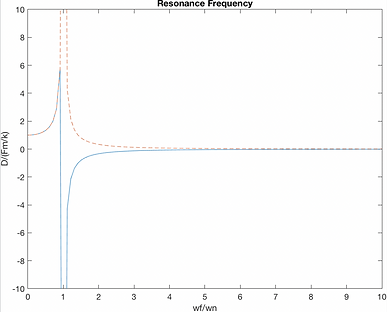
In a system with no dampening, we get resonance frequency when the natural frequency is the same as the forced frequency. The effects of resonance can be misalignment, unbalance, bearing faults, defect frequencies and even tool failure.
We see in the equation to the right that the D corresponds to the magnification factor, Fm/k represents the static deflection
In an ideal scenario with no dampening, as the forced frequency approaches the natural frequency the magnification factor (divided by the static deflection) goes to infinity.
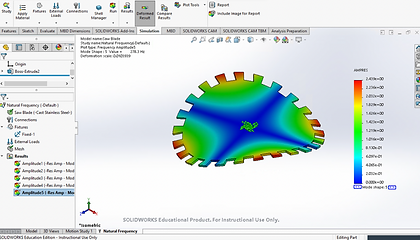


On the right is an animation of our 10 inch blade at an amplification factor of 4 and 5 to show its behavior as it approaches its natural frequency
Next, we designed 3 different models. As we varied the blade diameter, we notice that our frequency changes drastically (all models had a magnification factor of 5.
Both the number of teeth and their depth are the same, however the blades vary in diameter. We can see that even 2 inches on the diameter can drastically change the natural frequency.
10in Natural Frequency ≈278.3Hz
12in Natural Frequency ≈190.85Hz
14 in Natural Frequency ≈139.02Hz

The natural frequency of a table saw is the transverse vibrations of the saw. The forced frequency of a table saw is the rotation of the saw in the radial direction. The resonance occurs when the two are equal. When resonance occurs on a table saw the displacements of the system reach a point where the system can no longer support its function and can lead to complete destruction of the table saw
We researched the most common blade size for a table saw, and found the following details:
-
10 inch diameter blade
-
24 teeth evenly spaces (we assumed the depth of the tooth is the same as the spacing)
-
⅝ inch hole for the blade arbor
-
⅛ inch thick
-
Material: Cast Stainless Steel, Saw blade
-
Speed is 4000 rpm which translates to 66.7 Hz
Here we show an engineering drawing of our model saw, as well as, an isometric image and an image of the stresses that occur on the saw.

One thing that is desirable for a saw is the tooth speed. We can calculate the tooth speed by the following v = (w x r).
We convert the 66.7 Hz to rad/s and get 209.54 rad/s, We also convert the 5, 6, 7 inch radius to ft and get .417, .500 and .583 ft respectively
-
10 in diameter: v = (209.54 rad/s x .417ft) = 87.38 ft/s
-
12 in diameter: v = (209.54 rad/s x .500ft) = 104.77 ft/s
-
14 in diameter: v = (209.54 rad/s x .583ft) = 122.16 ft/s
In conclusion, we notice that although the the natural frequency is attainable for a table saw, it is not likely that the average household table saw will ever reach this frequency.
Keeping that in mind, we see that we do have to look out for larger diameters, because although we do not reach resonance, we can get a ratio of the magnification factor vs static deflection of 2 if we increase the radius of a saw blade at 10 inches by as little as 2 inches
Therefore, although a larger blade gets a faster tooth speed, it is more dangerous than using a smaller (10 inch) blade.